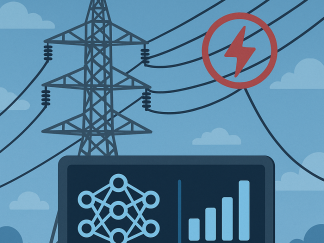



Powering the Future: Innovations in Modern Power Systems and How to Find It
Join an insightful webinar by Dr. Maanvi Bhatnagar on power systems, exploring modern grid technologies, renewable integration, and real-world challenges. Gain practical knowledge, industry insights, and future trends to enhance your understanding and career in electrical engineering and energy systems.
Register Now - FreeAbout This Webinar
This webinar introduces power system fundamentals, covering generation, transmission, and distribution, while highlighting modern trends, smart grids, renewable integration, and practical challenges shaping the future of electrical energy systems.
Key Publications & Research
Maanvi Bhatnagar’s research focuses on modern power system engineering, integrating advanced analytical methods with emerging technologies. Her work contributes to improving efficiency, reliability, and sustainability in electrical power networks.
Bhatnagar, Maanvi, Anamika Yadav, and Aleena Swetapadma. "A Fault Detection and Faulty Section Identification Scheme for Micro-Grids."
In 2022 Second International Conference on Power, Control and Computing Technologies (ICPC2T), pp. 1-6. IEEE, 2022.Bhatnagar, Maanvi, Anamika Yadav, Aleena Swetapadma, and Almoataz Y. Abdelaziz. "LSTM-based low-impedance fault and high-impedance fault detection and classification."
Electrical Engineering 106, no. 5 (2024): 6589-6613.Bhatnagar, Maanvi, Anamika Yadav, and Aleena Swetapadma. "Enhancing the resiliency of transmission lines using extreme gradient boosting against faults."
Electric Power Systems Research 207 (2022): 107850Bhatnagar, Maanvi, Anamika Yadav, and Aleena Swetapadma. "Fuzzy based relaying scheme for high impedance faults in DG integrated distribution system
Electric Power Systems Research 202 (2022): 107602Gupta, Gauri Shanker, Maanvi Bhatnagar, Shikhar Kumar, and Rakesh Kumar Sinha. "A comparative study of application of different non-conventional filters on electroencephalogram."
Biomed. Res 31 (2020): 1-9Why This Research Matters
Power system research ensures reliable, efficient energy supply, supports renewable integration, improves grid stability, enables smart technologies, reduces losses, and drives sustainable development, economic growth, and future electrification advancements.Who Should Attend
Electrical engineering students,diploma and polytechnic students,industry professionals,fresh graduates and job seekers,researchers and innovators,technicians and field engineersLearning Outcomes
Participants will understand power system fundamentals,analyze modern power system components,explore smart grid technologies,interpret power quality issues,learn about renewable energy integrationFeatured Speaker

Webinar Curriculum
A structured exploration of Power Systems Engineering, integrating theoretical foundations, technological advancements, and real-world system analysis.
• Definition and scope of electrical power system
• Core components: generation, transmission, and distribution
• Evolution from conventional grids to modern interconnected systems
• Power systems as the backbone of modern society
•Role in economic development and industrial growth
• Importance in daily life and critical infrastructure
• Global energy demand and electrification challenges
• Sustainability and environmental considerations
• Power losses and low efficiency
• Blackouts and system failures
• Poor power quality and reliability issues
• Fundamental electrical laws and system modeling
• Load flow, fault analysis, and stability studies
• Protection systems and relaying principles
• Voltage and frequency control mechanisms
Descriptive:
• Generators, transformers, and transmission networks
• Substations and switchgear systems
• SCADA and monitoring technologies
• Digital communication in power networks
Implications:
• Transition toward smart and automated grids
• Increased system efficiency through digitalization
• Importance of resilient and adaptive infrastructure
• Challenges in managing complex interconnected systems
• Smart grids and intelligent energy systems
• Integration of IoT and artificial intelligence
• Real-time monitoring and predictive maintenance
• Power systems are fundamental to modern civilization
• Ensuring reliability, efficiency, and sustainability is critical
• Technological advancements are reshaping energy systems
• Engineers play a vital role in future energy solutions
• Innovation will drive the evolution of global power infrastructure
Frequently Asked Questions
Previous Webinar Highlights
Watch our recent webinar recording
Institutes
12+
Countries
20+
Time
1h 26m
Rating
4.8/5
Global Participants
IIT Roorkee
IIT Hyderabad
NIT Raipur
Walailak University
United International University
University of Bucharest
Tshwane University of Technology
Instituto Superior Técnico (Portugal)
ENSAI – University of Ngaoundere (Cameroon)
University of Cantabria (Spain)
UTS (Australia)
Paytm
OurTestimonial


Jain (Deemed-to-be) University, School of Sciences
The webinar provided me with very good information about the topic…

University of Kerala
Interesting webinar.
Independent Researcher
Very informative session.
Kumaun University
Very interesting and informative session.
RP Ngoma College
I know how to generate electricity.
Rwanda Polytechnic - Ngoma College
Very interesting session.
Shahid Chamran University of Ahvaz
It was informative, hope to see more.
IPRC Ngoma
That is excellent
RP Ngoma College
The webinar was useful.
RP - Ngoma College
I'm interested to attend.
American University of the Middle East
Very technical presentation with detailed explanations…
M. B. G. P. G College Haldwani, Kumaun University Nainital
Session is very nice and knowledgeable. Great session.
Lebanese University
It is very interesting to hear about cerium oxide nanoparticles and their applications in biological activities.

S. K. V. T Government Degree College, Adikavi Nannaya University, Rajamahendravaram
Very informative. I gained knowledge about Nano technology.
Reserve Your Spot Today
Limited seats available for this transformative exploration of power system with Dr. Maanvi Bhatnagar.
Register Now
Supporting UN Sustainable Development Goals
This systems webinars support SDGs by promoting clean energy adoption, improving efficiency, enabling smart infrastructure, reducing emissions, and educating professionals to build sustainable, reliable, and accessible energy systems worldwide.
SDG 4: Quality Education
Provides technical knowledge and skill development for students and professionals in the energy sector.

SDG 3: Develop Reliable Infrastructure
Build quality, sustainable, and resilient infrastructure to support economic growth and human well-being.

SDG 9: Industry, Innovation and Infrastructure
Encourages development of modern, resilient power infrastructure and adoption of smart grid technologies.
How This Webinar Contributes to Global Goals
Promotes Clean Energy Adoption
Encourages the use of renewable energy sources, supporting global sustainability and reducing carbon emissions.
Enhances Energy Efficiency
Highlights modern technologies that reduce power losses and improve overall system performance.
Supports Reliable Power Access
Focuses on smart grids and innovations to ensure stable, affordable electricity for growing global needs.